
Supporting Safer Backcountry Experiences
A feature proposed by my team at SFU to enhance Avalanche Canada's existing app, designed to help inexperienced backcountry skiers make safer and more informed decisions by streamlining access to critical safety information for when it matters most.
A feature proposed by my team at SFU to enhance Avalanche Canada's existing app, designed to help inexperienced backcountry skiers make safer and more informed decisions by streamlining access to critical safety information for when it matters most.
COMPANY
COMPANY
Avalanche Canada
Avalanche Canada
ROLE
ROLE
UX UI Designer
UX UI Designer
TIMELINE
TIMELINE
1 Month
1 Month
TOOLS
TOOLS
Figma
Figma
01 - OVERVIEW
01 - OVERVIEW
The Client
The Client
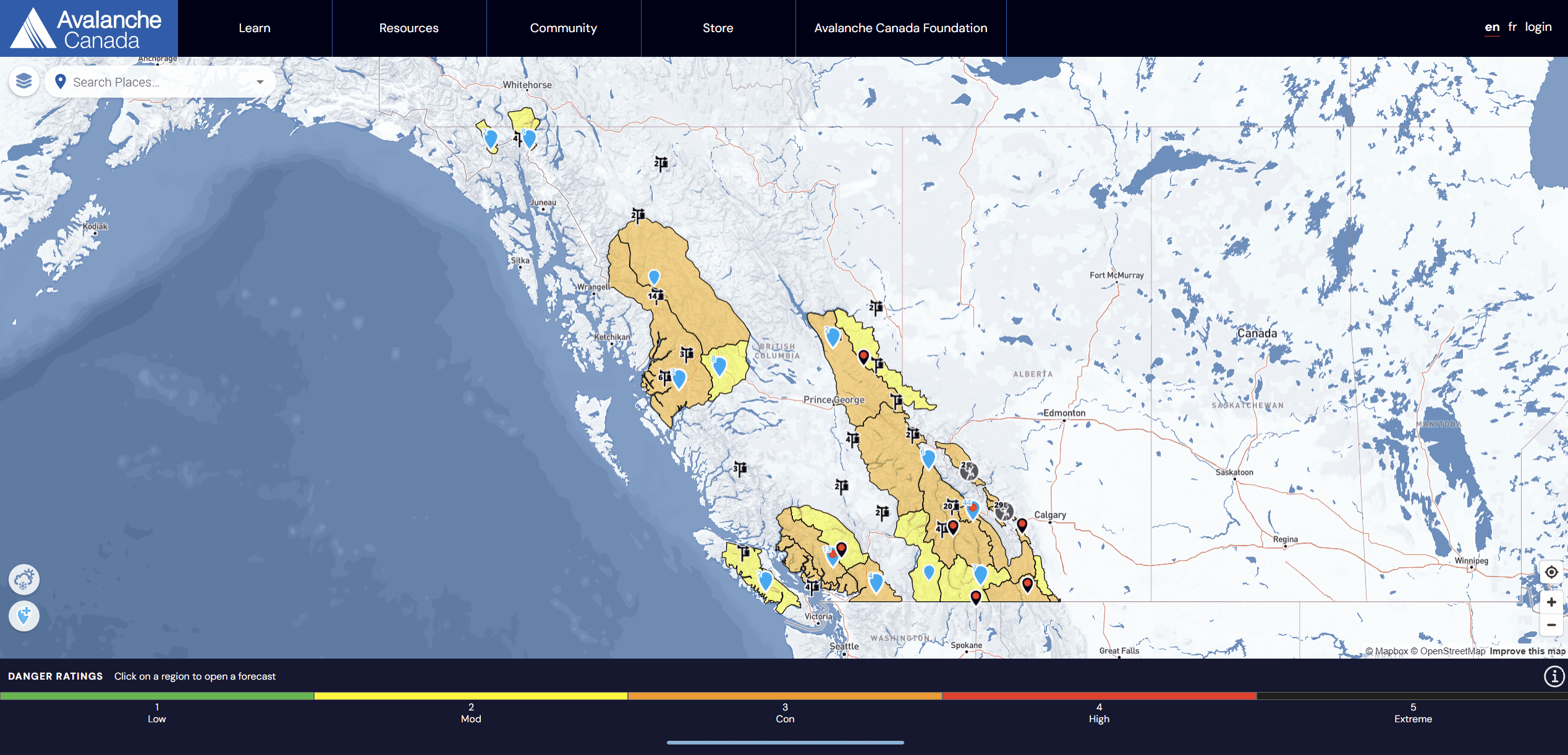
Avalanche Canada is a non-profit organization dedicated to enhancing public safety in Canada's winter backcountry. They provide daily avalanche forecasts, educational programs, awareness campaigns, and develop tools to improve forecast accuracy and reduce incidents for individuals exploring Canada's winter backcountry.
Avalanche Canada is a non-profit organization dedicated to enhancing public safety in Canada's winter backcountry. They provide daily avalanche forecasts, educational programs, awareness campaigns, and develop tools to improve forecast accuracy and reduce incidents for individuals exploring Canada's winter backcountry.
MISSION STATEMENT
MISSION STATEMENT
To inspire, engage, and empower recreationists to enjoy Canada's winter backcountry and be safe from avalanches.
To inspire, engage, and empower recreationists to enjoy Canada's winter backcountry and be safe from avalanches.
02 - RESEARCH
02 - RESEARCH
Key Data Insights
Key Data Insights
Our team was tasked with identifying a problem space and developing a intervention. As an avid skier, I was curious about how COVID had impacted the sport and led our team's research in that direction. During this research we found that interest in backcountry skiing was rising, bringing more inexperienced individuals into high-risk terrain.
Our team was tasked with identifying a problem space and developing a intervention. As an avid skier, I was curious about how COVID had impacted the sport and led our team's research in that direction. During this research we found that interest in backcountry skiing was rising, bringing more inexperienced individuals into high-risk terrain.
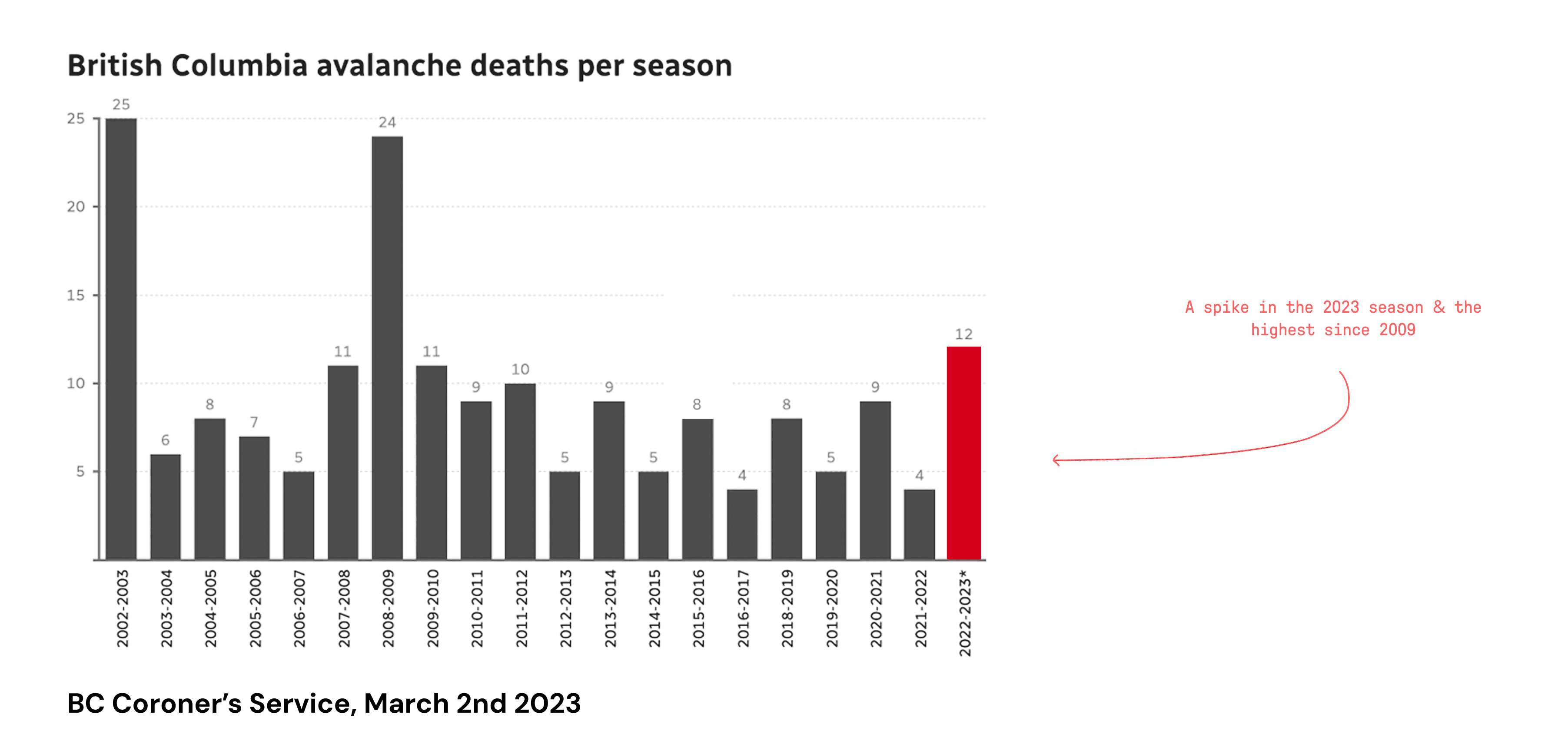
Coinciding with this surge was also a notable increase in avalanche related fatalities. This became especially apparent during the 2023 season, which was one of the deadliest on record for avalanche related fatalities in BC.
Coinciding with this surge was also a notable increase in avalanche related fatalities. This became especially apparent during the 2023 season, which was one of the deadliest on record for avalanche related fatalities in BC.
Over 4,400 backcountry access tickets were sold at Whistler Blackcomb in 2023, a 17% increase from the previous season.
Over 4,400 backcountry access tickets were sold at Whistler Blackcomb in 2023, a 17% increase from the previous season.
— Whistler Blackcomb Resort, 2023
— Whistler Blackcomb Resort, 2023
12 Avalanche related deaths recorded in the 2023 season, the highest since 2009.
12 Avalanche related deaths recorded in the 2023 season, the highest since 2009.
— BC Coroner's Service, 2023
— BC Coroner's Service, 2023
03 - USER RESEARCH
03 - USER RESEARCH
Knowledge and Access
Knowledge and Access
Following these key insights, we shifted our focus to the growing number of new backcountry skiers entering the sport. I conducted a series of interviews with skiers of varying experience levels, and what consistently emerged was that most struggled to learn the necessary material when first starting out, which had a direct impact on their confidence and ability to trust their judgment in the field.
Following these key insights, we shifted our focus to the growing number of new backcountry skiers entering the sport. I conducted a series of interviews with skiers of varying experience levels, and what consistently emerged was that most struggled to learn the necessary material when first starting out, which had a direct impact on their confidence and ability to trust their judgment in the field.
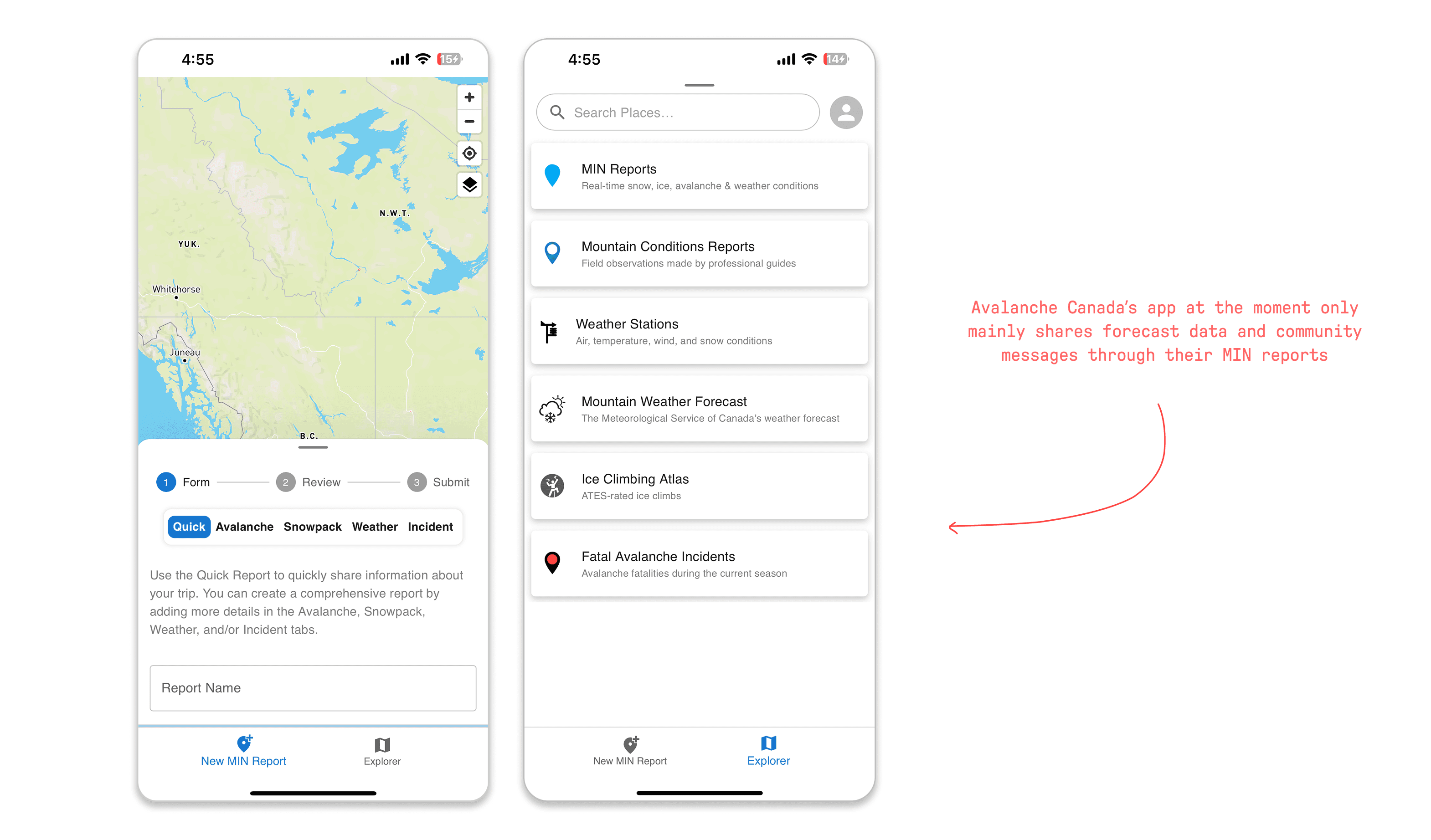
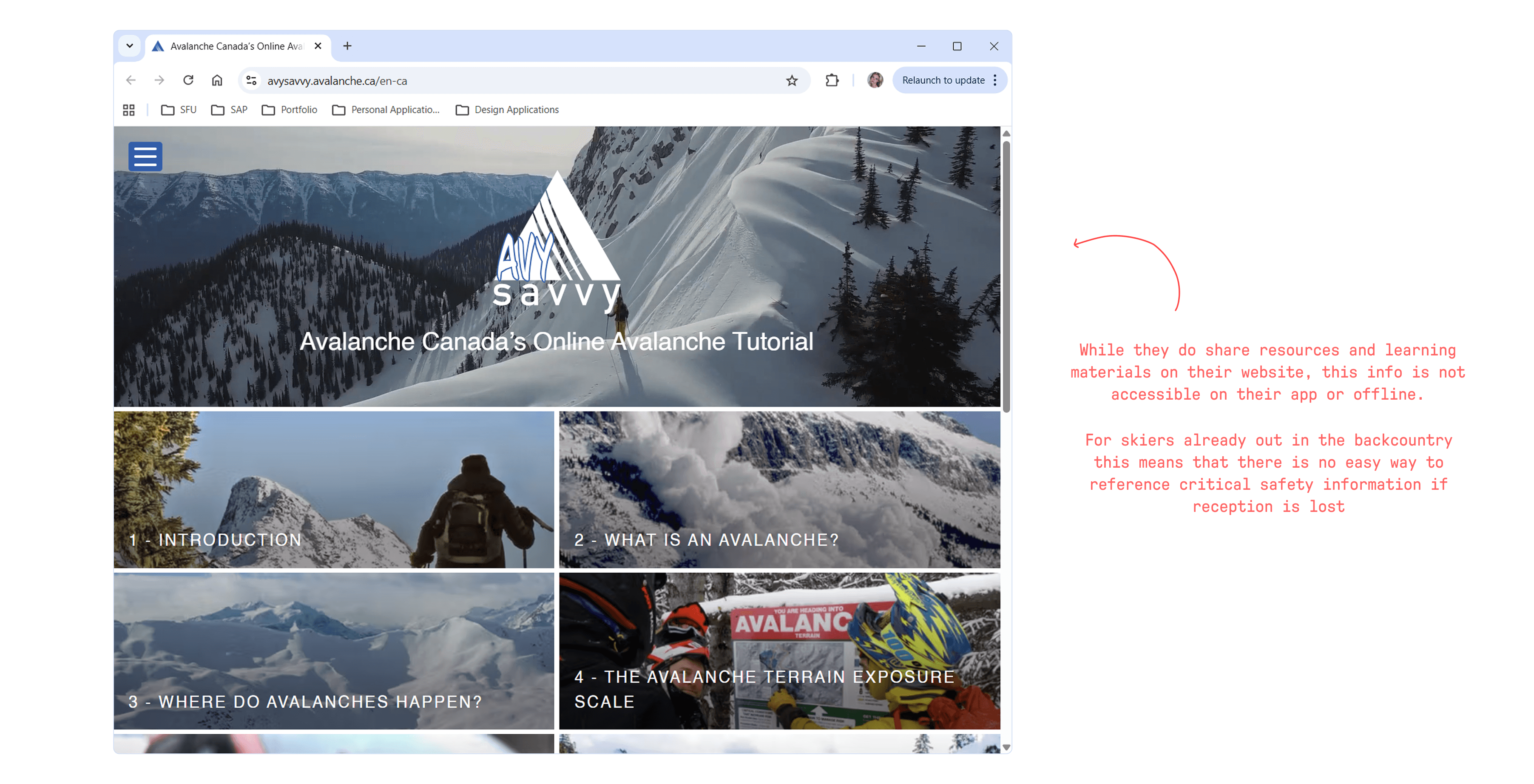
Additionally, while Avalanche Canada offers a wealth of information surrounding avalanche safety on their website, this information is solely accessible online through their website, and not included within their application, presenting a challenge for newcomers who must ensure they are well-prepared on all the details before heading out, especially in areas where reception may be lost.
Additionally, while Avalanche Canada offers a wealth of information surrounding avalanche safety on their website, this information is solely accessible online through their website, and not included within their application, presenting a challenge for newcomers who must ensure they are well-prepared on all the details before heading out, especially in areas where reception may be lost.
INTERVIEW INSIGHTS
INTERVIEW INSIGHTS
“I think the biggest thing was finding partners as a beginner who were ok with mentoring and letting me ask dumb questions. A lot of the culture expects you to be knowledgeable right off the bat, which can lead to people overselling their abilities or knowledge in order to not sound dumb.”
“I think the biggest thing was finding partners as a beginner who were ok with mentoring and letting me ask dumb questions. A lot of the culture expects you to be knowledgeable right off the bat, which can lead to people overselling their abilities or knowledge in order to not sound dumb.”
— Experienced Backcountry Skier A
— Experienced Backcountry Skier A
“I think the hardest thing for me was being able to be confident in my snow readings. I can identify the different slab types however I struggle to be confident when I’m actually skiing in these high risk areas which is why I like using the app to see good areas to go.”
“I think the hardest thing for me was being able to be confident in my snow readings. I can identify the different slab types however I struggle to be confident when I’m actually skiing in these high risk areas which is why I like using the app to see good areas to go.”
— Inexperienced Backcountry Skier B
— Inexperienced Backcountry Skier B
“I like to review my knowledge and terminology before the start of a reason to refresh but I wish there was a more straightforward refresher video page for people to watch or read a bit easier instead of having to click through the entire dictionary for terms.”
“I like to review my knowledge and terminology before the start of a reason to refresh but I wish there was a more straightforward refresher video page for people to watch or read a bit easier instead of having to click through the entire dictionary for terms.”
— Inexperienced Backcountry Skier C
— Inexperienced Backcountry Skier C
04 - DEFINE
04 - DEFINE
Problem Statement
Problem Statement
As the number of inexperienced backcountry skiers rises, so does the potential risk of avalanche related incidents. With limited support for out in the field, newcomers can’t access critical information if needed.
As the number of inexperienced backcountry skiers rises, so does the potential risk of avalanche related incidents. With limited support for out in the field, newcomers can’t access critical information if needed.
Framing
Framing
How might we streamline critical information for inexperienced backcountry skiers, enabling them to make confident, informed decisions and increase their safety when in the backcountry?
How might we streamline critical information for inexperienced backcountry skiers, enabling them to make confident, informed decisions and increase their safety when in the backcountry?
05 - WIREFRAMING
05 - WIREFRAMING
Structuring The Information
Structuring The Information
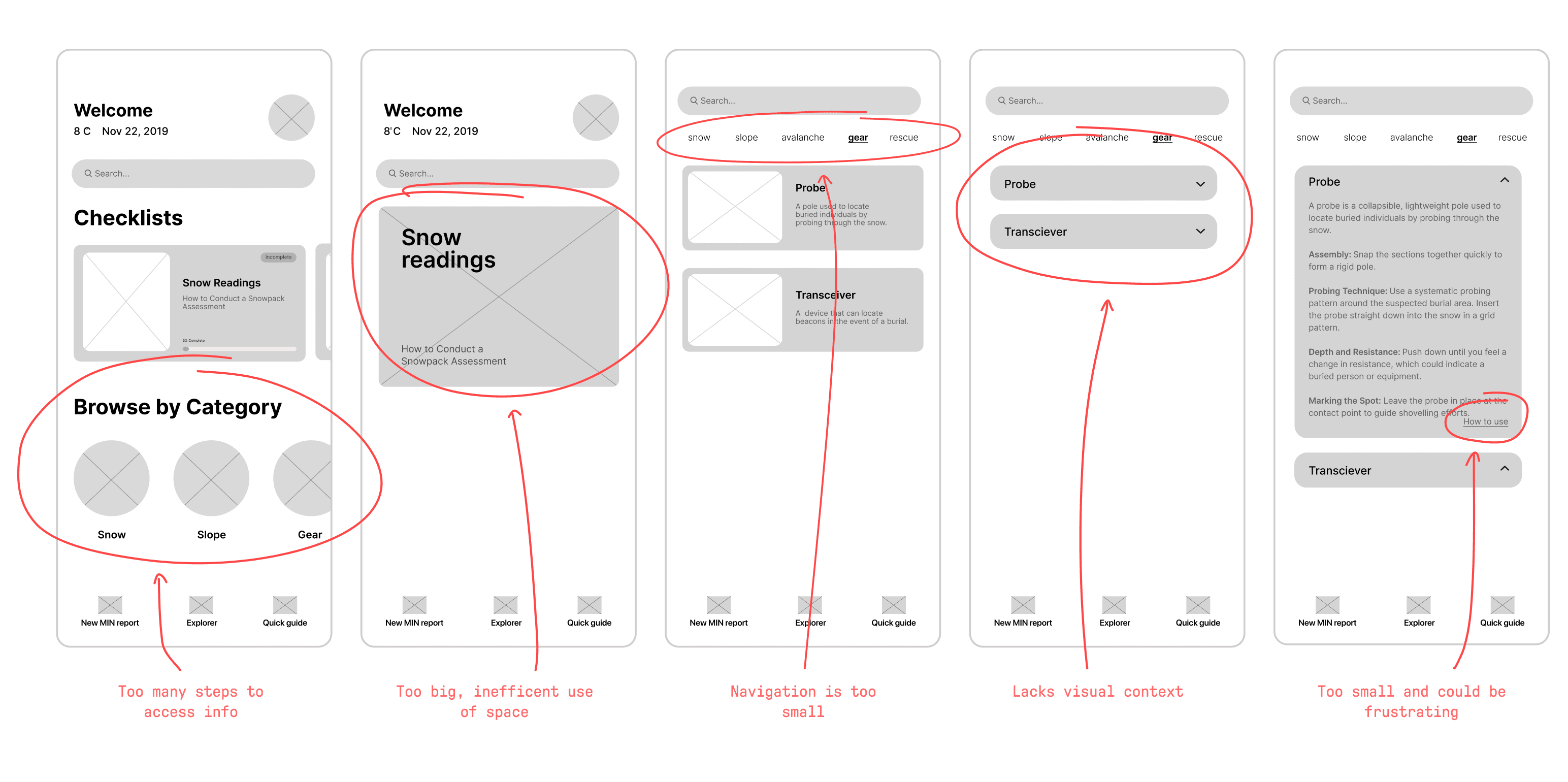
With the problem defined, our team moved into wireframing and exploring a range of concepts for how the feature could be structured within Avalanche Canada's existing app. The focus at this stage was on information architecture, and how to best structure the information so that users could find what they needed quickly and make informed decisions with confidence, even under pressure.
With the problem defined, our team moved into wireframing and exploring a range of concepts for how the feature could be structured within Avalanche Canada's existing app. The focus at this stage was on information architecture, and how to best structure the information so that users could find what they needed quickly and make informed decisions with confidence, even under pressure.
As a team we explored many wireframe variations, and during this process several issues became apparent. Critical safety information required too many steps to access, navigation elements were too small for reliable use with gloves on, and some layouts made inefficient use of available space. These findings pushed us toward a simpler, more direct structure with larger touch targets.
As a team we explored many wireframe variations, and during this process several issues became apparent. Critical safety information required too many steps to access, navigation elements were too small for reliable use with gloves on, and some layouts made inefficient use of available space. These findings pushed us toward a simpler, more direct structure with larger touch targets.
06 - FINAL DESIGN
06 - FINAL DESIGN
The Finished Features
The Finished Features
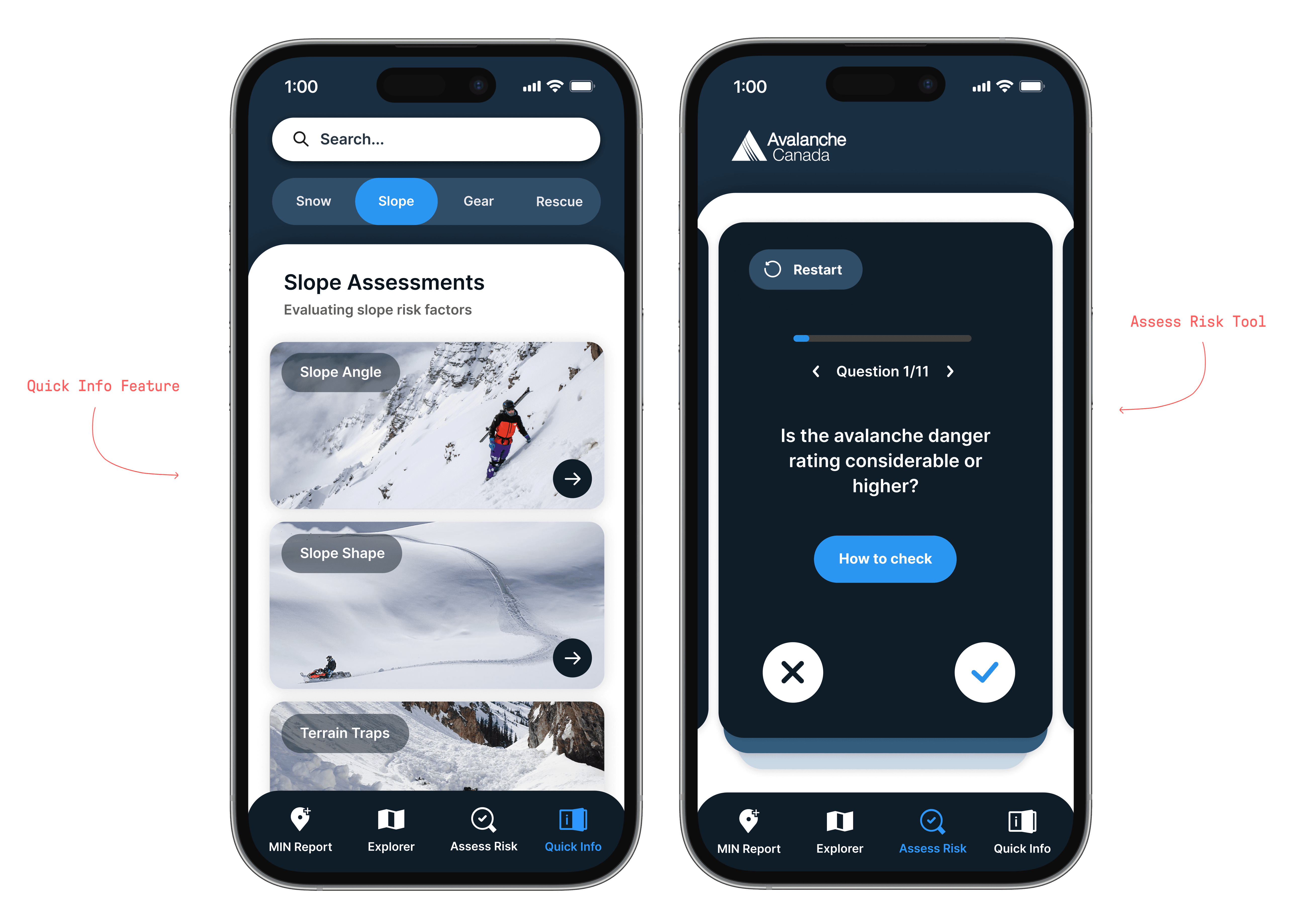
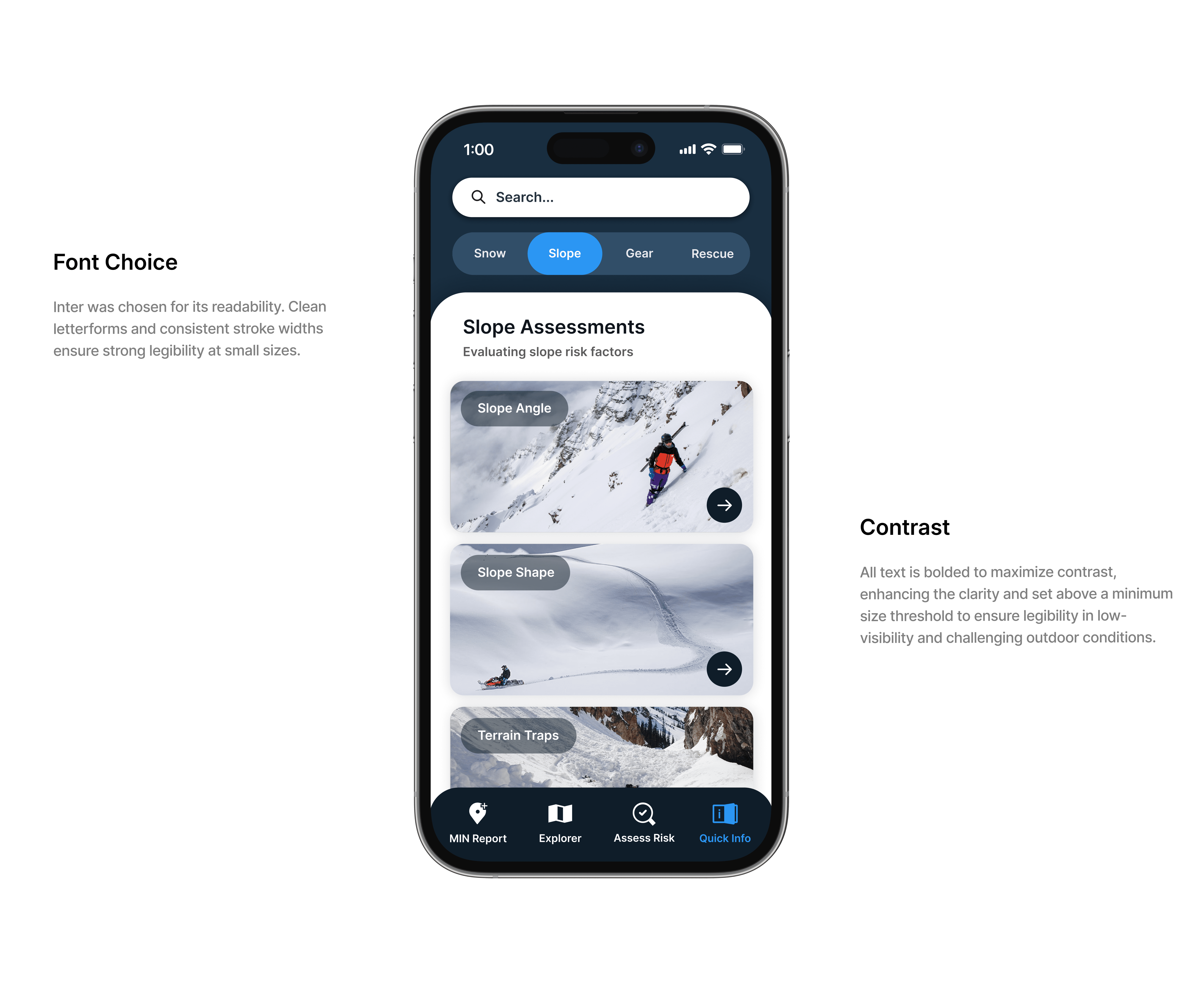
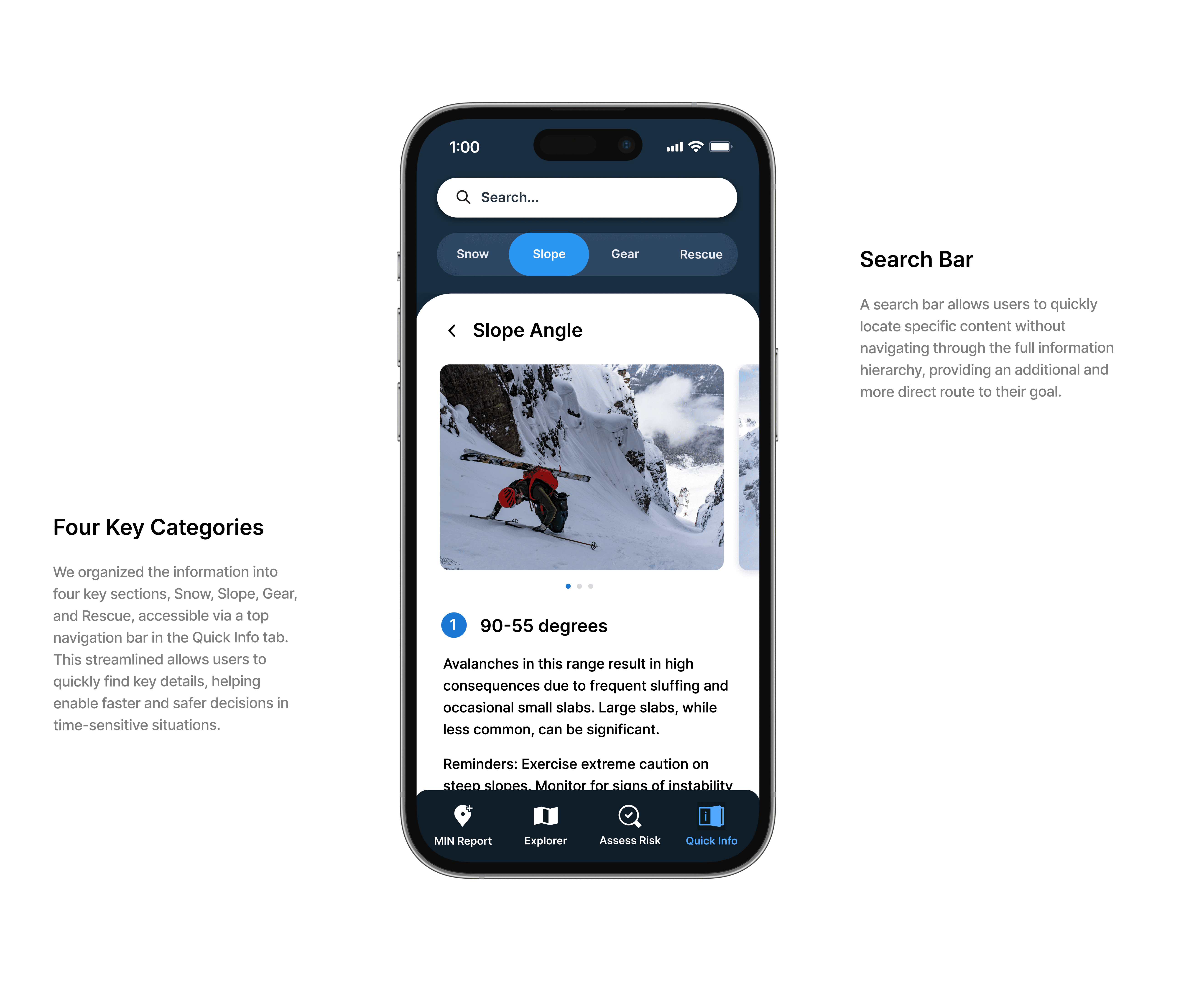
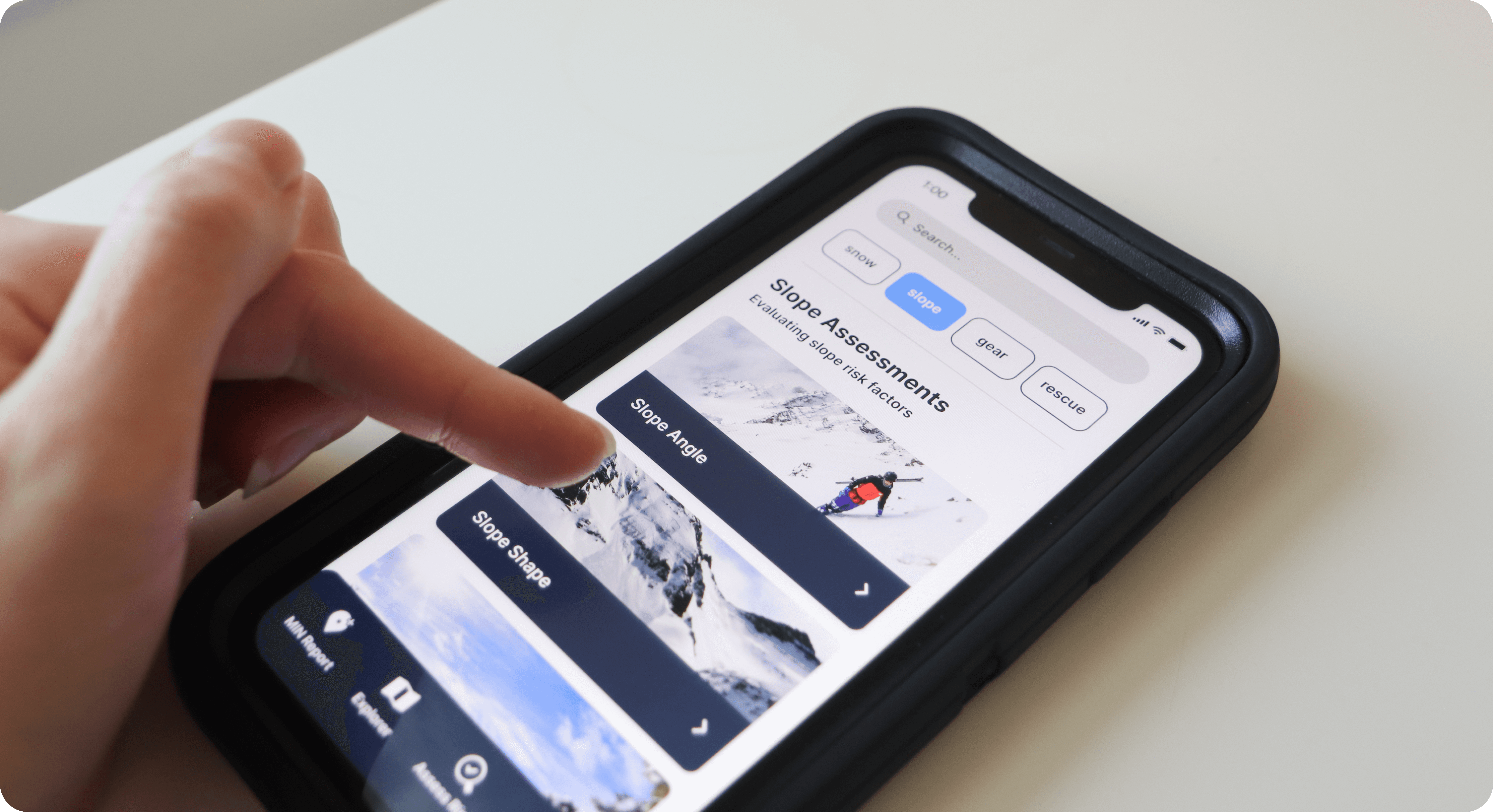
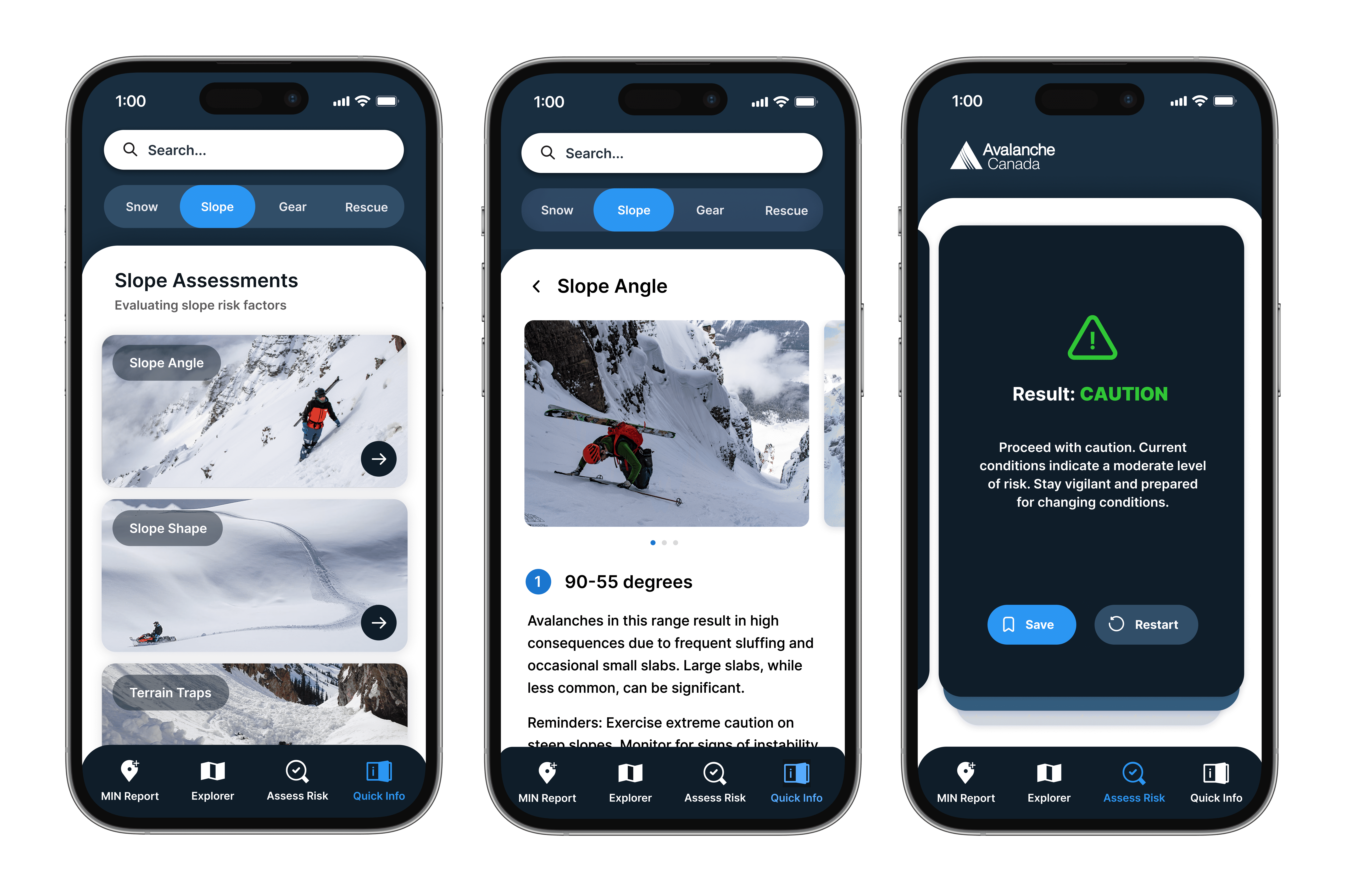
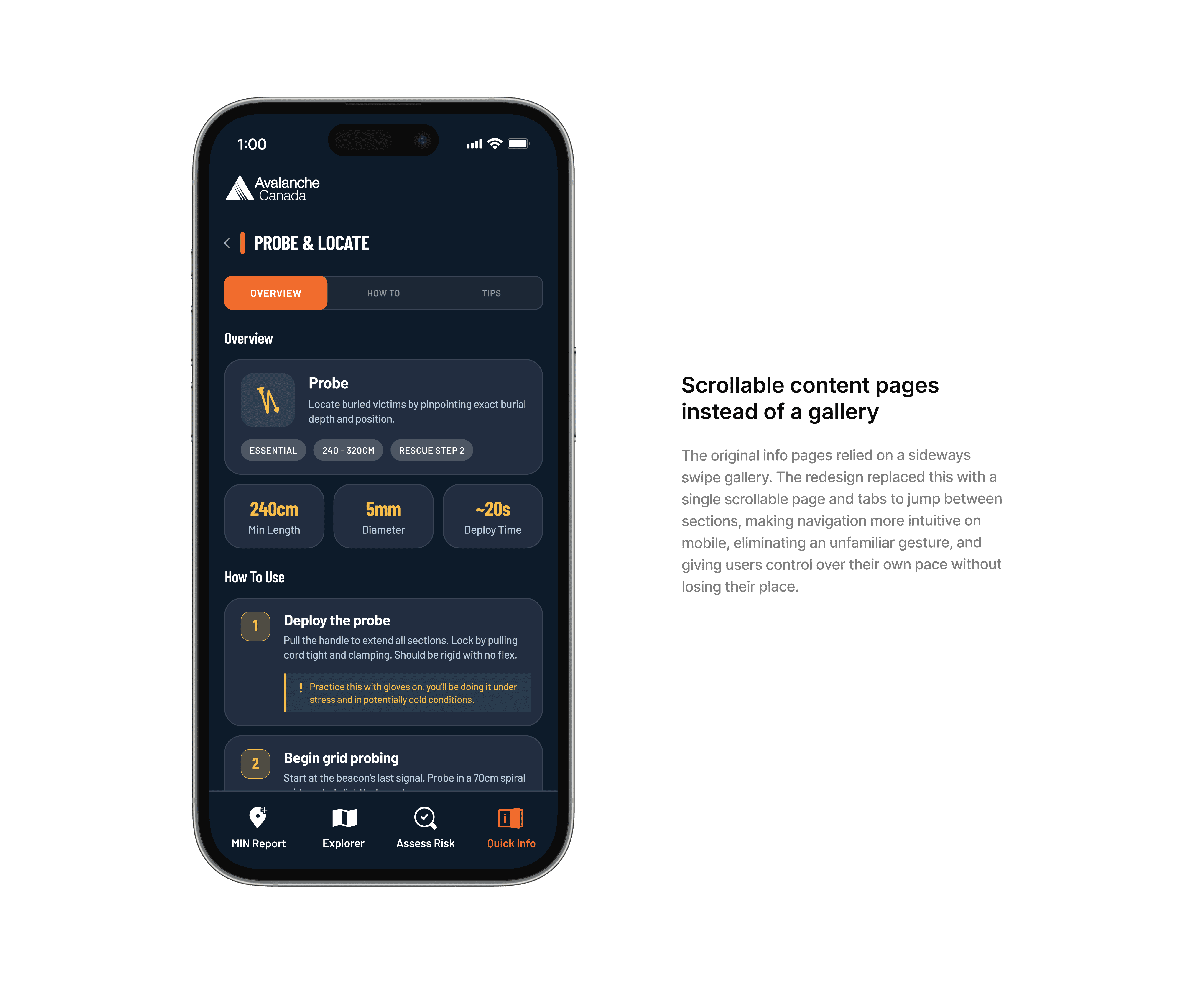
The final designs introduced two new features into Avalanche Canada's existing app: Quick Info and Assess Risk. Quick Info was designed for inexperienced backcountry skiers who are still building their knowledge, providing reliable on the go access to critical avalanche safety information needed to stay safe while out in the backcountry.
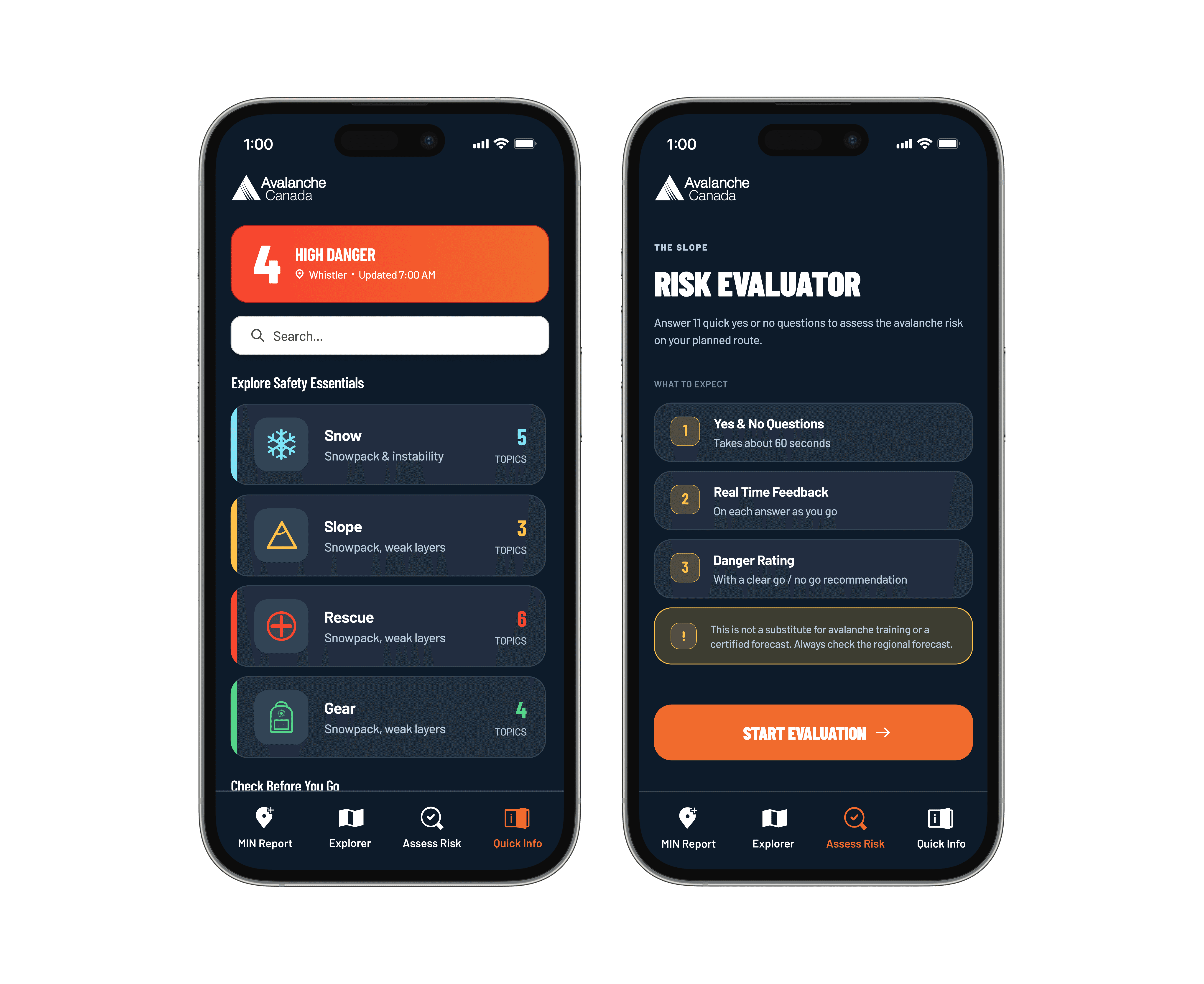
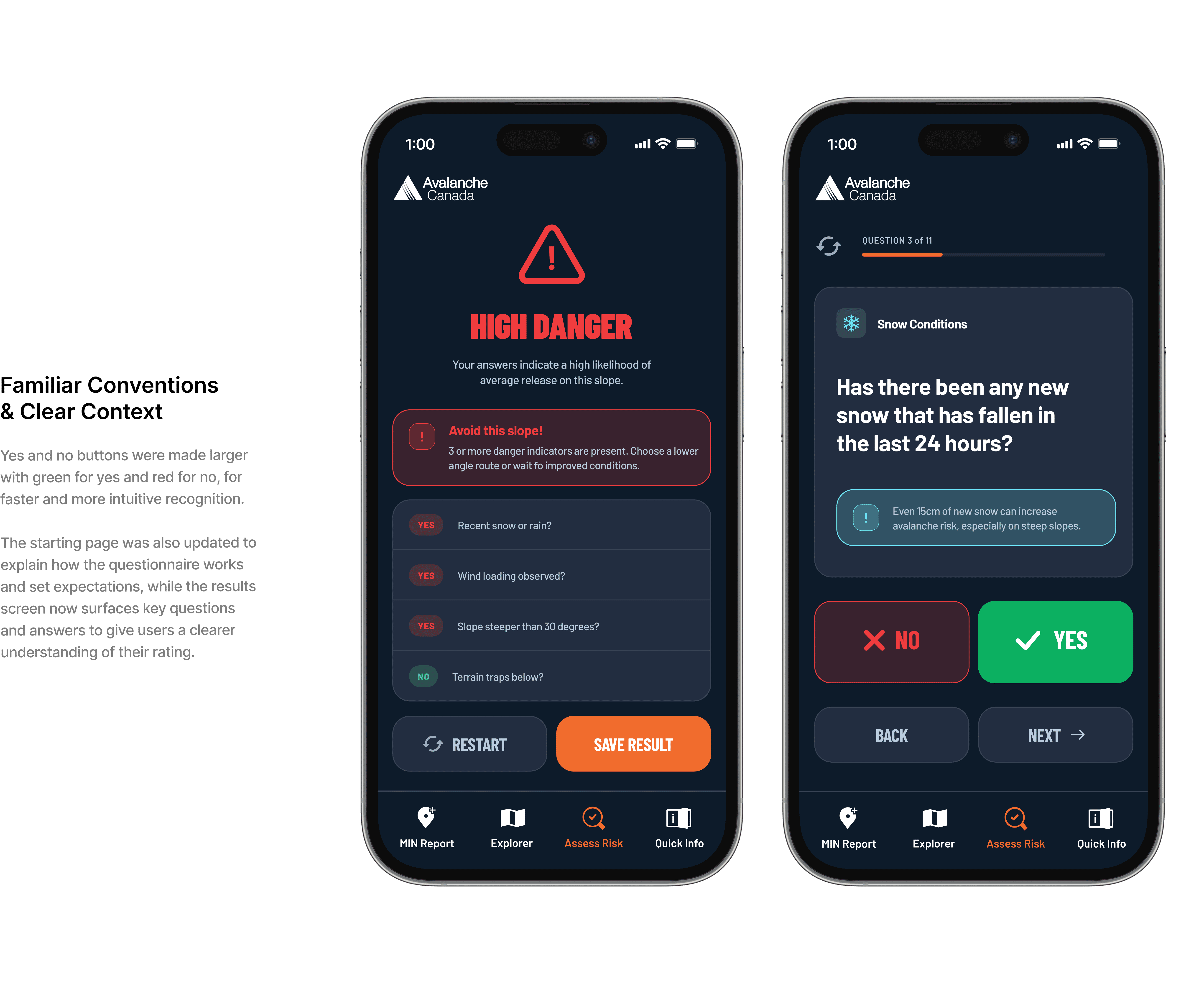
The second feature, Assess Risk, was a questionnaire tool designed to help inexperienced backcountry skiers evaluate the danger level of slopes before travelling on them. By answering a series of questions, users would receive a danger rating that they could save and refer back to for a clearer picture of the current avalanche conditions.
07 - TESTING
07 - TESTING
Validating The Design
Validating The Design
With a tight one month deadline, time for testing was limited. Despite this, we still tried to prioritize getting user feedback by building a prototype in Figma and conducting sessions using the think-aloud method with a group of users. The sessions surfaced one main useful finding, users found the thumbs-up and thumbs-down icons we had initially used in the questionnaire confusing.
With a tight one month deadline, time for testing was limited. Despite this, we still tried to prioritize getting user feedback by building a prototype in Figma and conducting sessions using the think-aloud method with a group of users. The sessions surfaced one main useful finding, users found the thumbs-up and thumbs-down icons we had initially used in the questionnaire confusing.
In response, we replaced them with a simple checkmark and X icon to reduce ambiguity and allow users to respond quickly without unnecessary delay. One user also suggested incorporating more location-specific recommendations, a feature we did not have time to implement within the project timeline but one that could meaningfully guide future iterations of the feature.
In response, we replaced them with a simple checkmark and X icon to reduce ambiguity and allow users to respond quickly without unnecessary delay. One user also suggested incorporating more location-specific recommendations, a feature we did not have time to implement within the project timeline but one that could meaningfully guide future iterations of the feature.
08 - OUTCOME
08 - OUTCOME
What It Delivered
What It Delivered
The final designs were built around one priority, getting critical safety information in front of users as quickly and clearly as possible. Every decision, from content hierarchy to type size to touch targets, was deliberate, driven by the specific challenges users would face in the field.
The final designs were built around one priority, getting critical safety information in front of users as quickly and clearly as possible. Every decision, from content hierarchy to type size to touch targets, was deliberate, driven by the specific challenges users would face in the field.
The resulting features gave inexperienced skiers something that had not previously existed within the app. Critical safety information available offline and a tool to assess slope risk on the go, both designed to support better decision making in the moments when it mattered most.
The resulting features gave inexperienced skiers something that had not previously existed within the app. Critical safety information available offline and a tool to assess slope risk on the go, both designed to support better decision making in the moments when it mattered most.
01
01
Critical info ready for when you need it
Critical info ready for when you need it
For the first time, inexperienced skiers could access essential safety content directly within Avalanche Canada's app without needing reception, available when and where it was needed most.
For the first time, inexperienced skiers could access essential safety content directly within Avalanche Canada's app without needing reception, available when and where it was needed most.
02
02
Clear results, faster decisions
Clear results, faster decisions
Rather than requiring users to manually calculate their risk level, the Assess Risk feature provided an immediate result, providing users with the information they needed to make safer decisions in the field.
Rather than requiring users to manually calculate their risk level, the Assess Risk feature provided an immediate result, providing users with the information they needed to make safer decisions in the field.
03
03
Being better equipped from the start
Being better equipped from the start
For those getting into the sport, these features ensured that newcomers had the support and resources needed to build their confidence and keep themselves safe as they gained experience.
For those getting into the sport, these features ensured that newcomers had the support and resources needed to build their confidence and keep themselves safe as they gained experience.
IMPACT
IMPACT
Created for a sport that saw a 17% surge in participation in 2023 and had the 4th deadliest avalanche season in two decades, where access to critical safety information could be the difference between a safe trip and a fatal one.
Created for a sport that saw a 17% surge in participation in 2023 and had the 4th deadliest avalanche season in two decades, where access to critical safety information could be the difference between a safe trip and a fatal one.
09 - LOOKING BACK
09 - LOOKING BACK
What I Would Do Now
What I Would Do Now
Returning to this project, one thing I would approach differently is validating the content with users in a real context. While we were able to get in some user testing before the deadline, we never had the chance to confirm whether what we included would actually be useful out in the field. Given more time, taking the prototype into the backcountry and testing it in a real environment would have been an important step before finalizing the feature.
Returning to this project, one thing I would approach differently is validating the content with users in a real context. While we were able to get in some user testing before the deadline, we never had the chance to confirm whether what we included would actually be useful out in the field. Given more time, taking the prototype into the backcountry and testing it in a real environment would have been an important step before finalizing the feature.
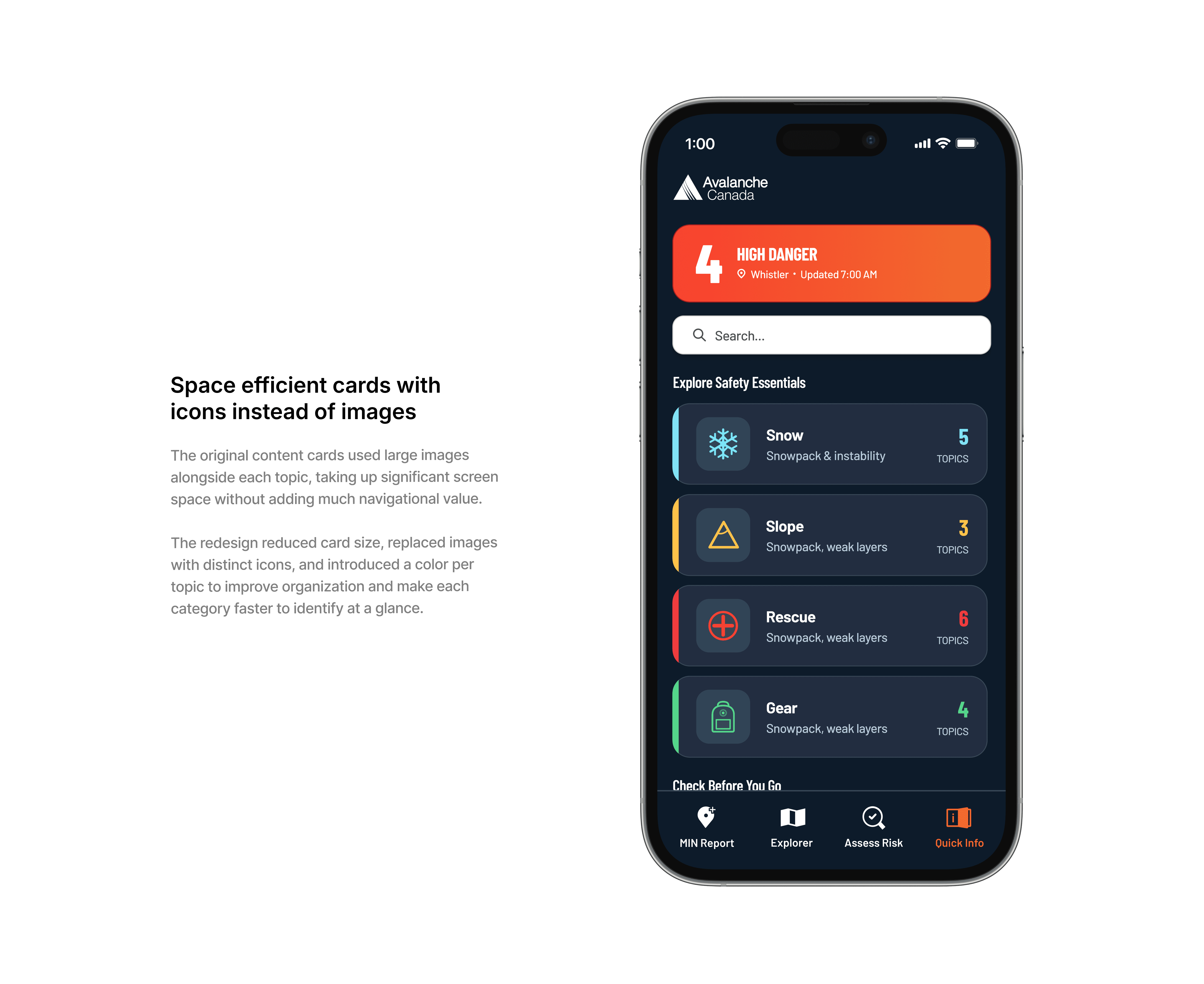
Beyond the process, there were also design decisions I felt could've been pushed further. Several choices had prioritized aesthetics over usability in a context where speed and clarity needed to come first. With this in mind, I revisited the designs and explored a future direction that addressed these issues, leaning into established patterns and gestures so users could interact instinctively without learning new conventions in a high pressure situation.
Beyond the process, there were also design decisions I felt could've been pushed further. Several choices had prioritized aesthetics over usability in a context where speed and clarity needed to come first. With this in mind, I revisited the designs and explored a future direction that addressed these issues, leaning into established patterns and gestures so users could interact instinctively without learning new conventions in a high pressure situation.
10 - REFLECTION
10 - REFLECTION
What I Learned
What I Learned
Don't reinvent the wheel
Don't reinvent the wheel
This project taught me the importance of designing with established patterns and conventions in mind. In a high stakes context like backcountry safety, users shouldn't have to stop and try to figure out how something works. By understanding what gestures, interactions, and visual cues people are already familiar with, we can remove friction and let users focus entirely on the decisions that matter.
Reducing cognitive overload
Reducing cognitive overload
Simplifying complex, high-stakes information was one of the most challenging parts of this project. Designing for users who may be under pressure, in the cold, and without reception meant that every unnecessary step was a liability. Cutting content down to only what was critical and making results instant rather than manual reinforced how much clarity and restraint matter in high stakes design.